



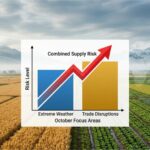

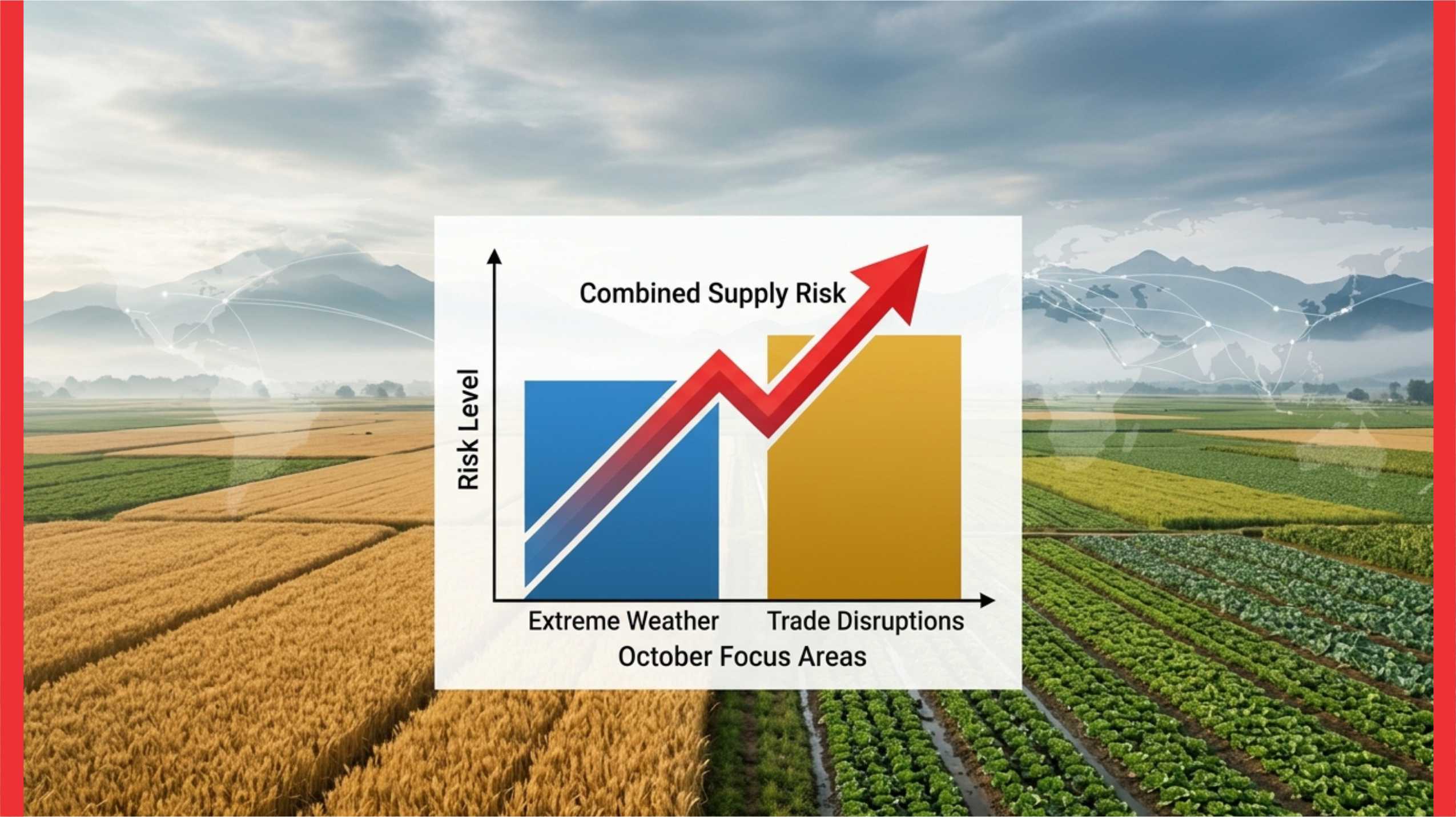
Global agricultural supply risks have continued to broaden since the September BuyerMetrics Commodity Supply Risk Watch, as weather concerns, trade disruptions and tighter production expectations put pressure on several major crops.
The global market is not facing a broad-based shortage. FAO still expects 2026 cereal production to reach about 2.979 billion tons, the second-highest harvest on record. But the supply cushion is becoming less comfortable, particularly for commodities exposed to weather and disrupted trade routes.
Cocoa: Very High Risk
Cocoa remains the commodity with the highest supply risk. Weather conditions are becoming more difficult across several producing regions, with excessive rainfall raising disease risks in parts of Ecuador while dry conditions are affecting parts of Indonesia.
West African crop conditions remain critical because Côte d’Ivoire and Ghana account for a large share of global production. Any deterioration across the major origins could quickly tighten global availability.
Risk: Very High →
What to watch: Côte d’Ivoire and Ghana crop conditions, Ecuador rainfall and disease, Indonesia’s dry spell, West African pod development, early harvest arrivals and global inventories.
Wheat: High Risk
Wheat remains exposed to both production and logistics risks. Black Sea shipping disruptions are affecting export prospects from Russia and Ukraine, while weather concerns remain in several producing regions.
Global production is still large following FAO October’s forecast of 813.9 million tons, but the ability to move wheat efficiently to importing markets has become a bigger part of the supply equation.
FAO also lowered its expectations for Russian and Ukrainian wheat exports because of constrained shipping routes. Kazakhstan’s higher export prospects are not sufficient to fully offset the reductions.
Risk: High ↑
What to watch: Black Sea port activity, Russian and Ukrainian exports, shipping costs, Australian weather, winter wheat planting and global stocks.
Sugar: Very High Risk
Sugar has become one of the fastest-rising supply risks. FAO’s sugar index jumped 6.1% in September, reflecting concerns over 2026/27 production.
Brazil is central to the risk. Heavy rain is disrupting Brazil’s harvest, while below-normal rainfall in India and weaker prospects in Thailand are adding pressure. El Niño is increasing uncertainty across the major producing regions.
Risk: Very High ↑
What to watch: Brazilian rainfall and cane harvesting, sugar-to-ethanol production mix, Indian rainfall, Thai production, EU beet output and global export availability.
Maize: High Risk
Maize has moved from Moderate in September to High Risk as production expectations weaken in some major growing regions.
FAO has reduced its forecast for global coarse-grain production to 1.612 billion tons, down 1.3% from the previous year. The outlook is tightened by lower US and European production prospects, reduced Brazilian export availability and Black Sea logistics. Strong feed and biofuel demand adds another source of pressure.
Risk: High ↑
What to watch: US yields, European production, Black Sea exports, Brazilian shipments, global inventories, feed demand and ethanol demand.
Soybeans: Moderate Risk
Soybeans remain relatively comfortable compared with other major commodities. The US harvest is adding supply, while Brazil is preparing for another major crop.
The main risk is demand. Strong crushing and biofuel demand could reduce the supply cushion if South American weather becomes less favourable.
Risk: Moderate →
What to watch: US harvest and yields, Brazilian planting, soybean crushing, Chinese purchases, South American weather and biofuel demand.
Palm Oil: Moderate-High Risk
Palm oil risk is increasing as weather and demand pressures converge in Southeast Asia. Dry conditions could affect production in Indonesia and Malaysia, the world’s dominant suppliers.
The FAO Vegetable Oil Price Index rose 0.9% in September, with palm oil providing much of the increase. Palm oil prices rose for a fourth consecutive month as strong global import demand coincided with concerns over the effect of dry weather on production in Southeast Asia
On the side of palm oil demand, biofuel demand is competing with food demand for available palm oil, making the market more sensitive to any production slowdown.
Risk: Moderate-High ↑
What to watch: Indonesia and Malaysia rainfall, fresh fruit bunch yields, palm oil inventories, Indonesian biodiesel demand, exports and replanting activity.
Rice: Moderate-High Risk
Rice has moved higher on the risk scale as weather concerns grow across Asia. With weaker prospects in India linked to uneven monsoon rainfall, FAO has reduced its 2026/27 production forecast to 552.5 million tons on a milled basis, 0.7 million tons below its September forecast and 2.4% below the previous season’s record.
Large global stocks provide some protection, but India’s production and export decisions remain critical to international availability.
Risk: Moderate-High ↑
What to watch: Indian production and export policy, monsoon conditions, Thailand and Vietnam shipments, Asian stocks, planting conditions and weather.
Cashew: Moderate Risk
Cashew remains at Moderate Risk, with West African production and processor demand continuing to shape the market.
West African supply remains important to the global market, particularly for countries such as Côte d’Ivoire, Guinea-Bissau, Nigeria and Benin.
The market is also closely linked to processors in Vietnam and India. Changes in processor buying activity can quickly alter demand for African raw cashew nuts and affect farmgate and export prices.
Risk: Moderate →
What to watch: West African crop conditions, Nigerian RCN availability, farmgate prices, Vietnam and India processing demand, freight costs and African export flows.
Coffee: Moderate Risk
Coffee remains at Moderate Risk, with improved Brazilian availability providing some relief to the global market.
However, the crop remains highly weather-sensitive. Brazil’s arabica production and Vietnam’s robusta supply will remain the key variables to watch through the next production cycle.
Risk: Moderate →
What to watch: Brazilian production and exports, Vietnam’s robusta crop, rainfall, flowering conditions, inventories and global shipments.
October Commodity Supply Risk Snapshot
| Commodity | September | October | Direction | Main Factors | |
| Cocoa | Very High | Very High | → | Weather, disease, pod development | |
| Wheat | High | High | ↑ | Black Sea logistics, weather, export flows | |
| Sugar | High | Very High | ↑ | Brazil harvest, India, Thailand, El Niño | |
| Maize | Moderate | High | ↑ | US/EU yields, Black Sea, Brazilian exports | |
| Soybeans | Moderate | Moderate | → | US harvest, demand, South American weather | |
| Palm Oil | Moderate | Moderate-High | ↑ | Southeast Asian weather, biofuels, demand | |
| Rice | Moderate | Moderate-High | ↑ | India, monsoon, Asian production | |
| Cashew | Moderate | Moderate | → | West African supply, weather, processing demand | |
| Coffee | Moderate | Moderate | → | Brazil, Vietnam, weather |
BuyerMetrics Commodity Supply Risk Watch: MODERATE-HIGH
Direction: ↑ Rising
Highest-risk commodity: Cocoa
Fastest-rising risks: Sugar, Maize, Palm Oil and Rice
Main global threats: Weather, El Niño, Black Sea logistics and competing food-energy demand