





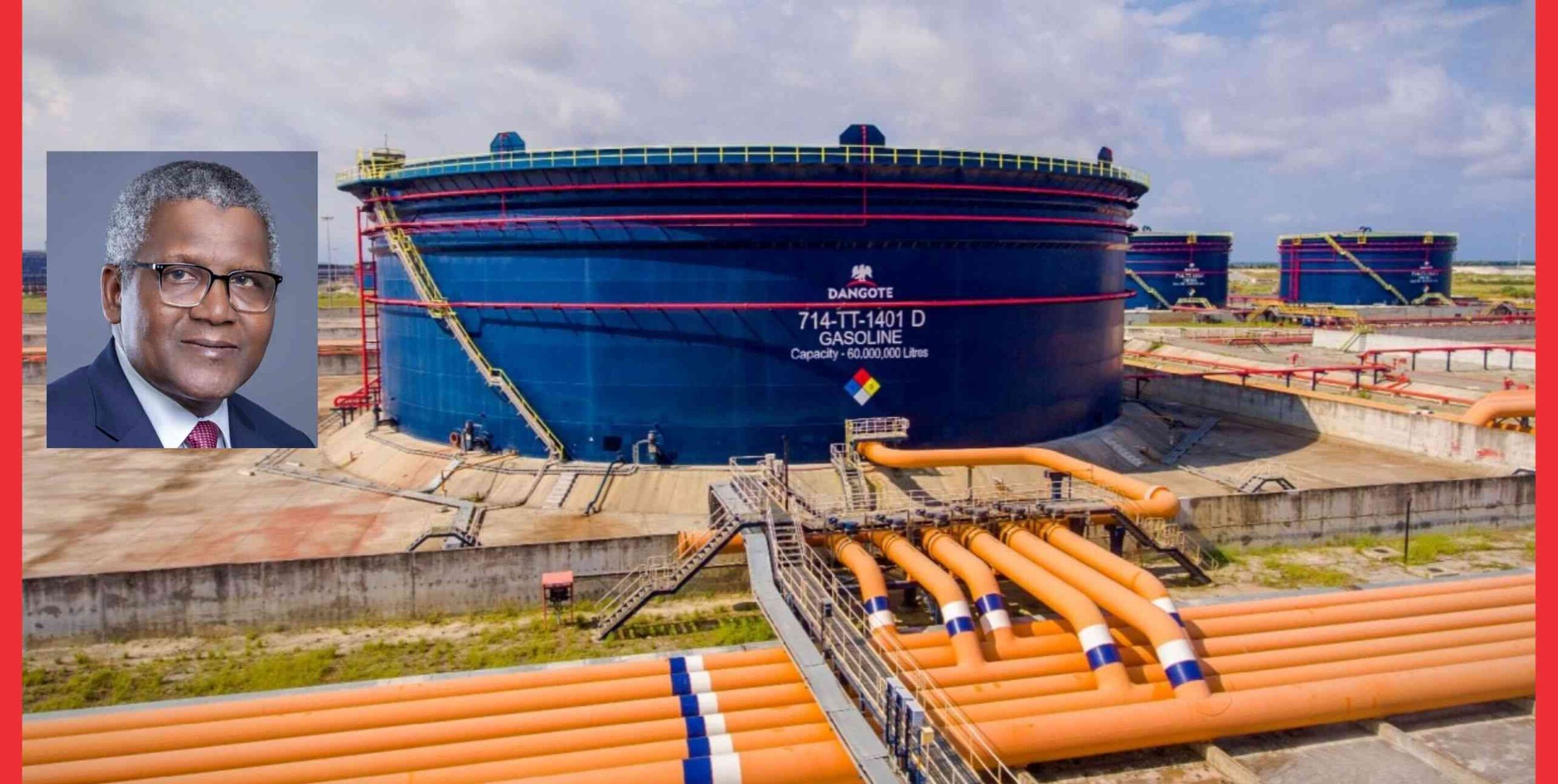
The Dangote Petroleum Refinery operated at between 98% and 101% capacity utilization from April to June 2026, while supplying an average of 50 million litres of petrol daily to Nigeria’s domestic market, according to Dangote Group’s H1 2026 Macroeconomic Report.
The report, titled Between Windfall and Inflation, was prepared by the group’s Economic Research and Intelligence Unit. It highlights the refinery’s rising output, declining dependence on imported petrol and growing presence in international refined petroleum markets.
Daily petrol supply reached a record 56 million litres in April, against a planned evacuation of approximately 1.1 million tons monthly.
The report also disclosed that the refinery’s processing capacity was rerated from 650,000 barrels per day to 700,000 barrels per day in June, reflecting an expansion of its refining operations.
Beyond petrol, the facility was supplying approximately 25 million litres of diesel daily and up to 29 million litres of aviation fuel, while exporting surplus refined products across West Africa and other international markets.
Petrol imports fall as domestic refining expands
The increase in domestic refining has coincided with a decline in Nigeria’s petrol imports, although imported supplies remain part of the domestic market.
According to the Nigerian Midstream and Downstream Petroleum Regulatory Authority (NMDPRA), Nigeria’s average daily petrol imports fell by 26% to 14.6 million litres in August 2026, from 19.7 million litres in July.
During the same month, Dangote Refinery recorded average capacity utilisation of 105.21%, producing 41.94 million litres of petrol daily, alongside 18.01 million litres of diesel and 24.48 million litres of aviation fuel.
Domestic petrol receipts averaged 35.87 million litres daily, while exports stood at 9.73 million litres. Closing petrol stocks reached 360.4 million litres.
The figures indicate that the refinery’s role extends beyond meeting domestic demand, with part of its production supplying export markets. However, the difference between production, domestic receipts and exports also highlights the importance of tracking inventories and product distribution when assessing actual supply to Nigerian consumers.
The reduction in imports has also coincided with a sharp fall in Nigeria’s petrol import bill.
Data from the National Bureau of Statistics (NBS) showed that petrol imports fell to ₦87.40 billion in the first quarter of 2026, from ₦2.27 trillion in the corresponding period of 2025, representing a decline of approximately 96.15%.
The reduction points to a major shift in the composition of Nigeria’s petroleum supply. However, import expenditure can also be affected by prices, exchange rates and shipment timing, meaning the decline should not be attributed to refinery output alone.
Refined petroleum exports gain momentum
Dangote Refinery’s expanding production has also strengthened Nigeria’s position as an exporter of refined petroleum products.
According to the H1 report, Nigeria’s refined petroleum product exports increased by 51% year-on-year in the first quarter of 2026.
The refinery’s growing presence in European markets has been particularly visible in aviation fuel shipments. Dangote Group reported that the facility became Europe’s largest single supplier of jet fuel in June and July, exporting more than 400,000 tons to the continent in July alone.
In September, Aliko Dangote disclosed that the refinery had sold out its jet fuel supply to European markets for August and September, with remaining stocks reserved for Nigeria.
Its total aviation fuel export to Europe is estimated at over 800,000 metric tons in the third quarter of 2026
In a separately report, seaborne refined petroleum exports from Nigeria to Europe rose to approximately 130,000 barrels per day in the second quarter of 2026, compared with 15,000 barrels per day in 2023.
The export growth marks a change in Nigeria’s traditional petroleum trade pattern, in which the country exported crude oil and relied heavily on imported refined products.
However, the long-term impact will depend on the refinery’s ability to sustain production, maintain export competitiveness and supply the domestic market reliably.
Conclusion
Dangote Refinery’s reported 101% capacity utilization and average daily petrol supply of 50 million litres in the first half of 2026 underline the growing importance of domestic refining to Nigeria’s petroleum market.
The next test is whether this operating performance can translate into consistently lower import dependence, reliable domestic supplies and sustained export earnings. The refinery’s output is changing Nigeria’s petroleum trade, but its lasting economic impact will be measured by how much of that increased capacity translates into dependable supply and broader benefits for the economy.