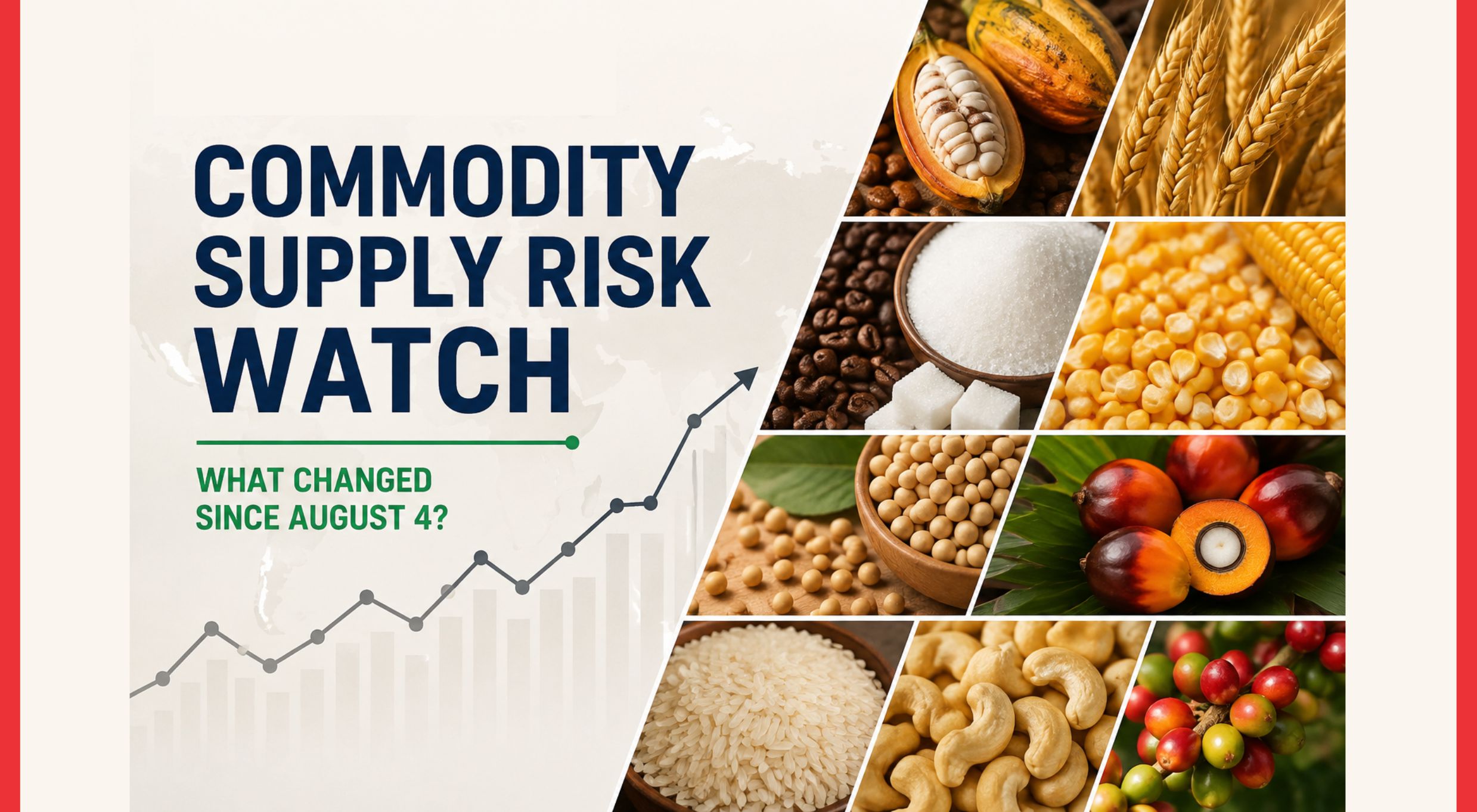
Global agricultural supply risks have broadened since the last BuyerMetrics Commodity Supply Risk Watch published on August 4, with weather, trade disruptions and changing demand putting more markets under pressure.
Cocoa remains the commodity facing the highest supply risk, while wheat continues to face threats from Black Sea disruptions and adverse weather. Sugar has emerged as a major concern, while maize and soybeans have moved from Low to Moderate risk as crop and demand pressures increase.
Coffee is the notable exception. Improving Brazilian availability has eased its immediate supply risk.
The shift comes as global agricultural markets become increasingly sensitive to weather and geopolitical disruptions. The FAO reported in August that its Cereal Price Index rose 3.4% from June, with wheat, sugar and vegetable oils among the markets affected by weather and supply concerns.
Cocoa Retains the Biggest Supply Risk
Cocoa remains at Very High Risk, with conditions deteriorating further since the August 4 assessment occasioned by weather
In Côte d’Ivoire, cloudy weather and limited sunshine have slowed pod development and could delay arrivals at ports. September arrivals are expected to remain below normal seasonal levels, raising concerns by Ivory Coast’s Coffee and Cocoa Council about congestion later in the harvest as beans move through the export system.
Field conditions are also becoming more difficult. Persistent humidity and excessive rainfall across parts of Côte d’Ivoire and Ghana are increasing the risk of Black Pod disease.
At the same time, below-average cherelle formation in Côte d’Ivoire points to weaker future pod development. Ghana has also reduced its 2026/27 production outlook, reflecting continuing structural problems including ageing trees and disease.
Risk assessment: Very High ↑
What to watch: Côte d’Ivoire port arrivals, rainfall and sunshine, Black Pod incidence, pod development, Ghana’s production outlook and global inventories.
Wheat Remains Under Pressure
Wheat remains at High Risk, with the situation worsening since August.
Situation around the Black Sea posses a major source of uncertainty as Russia and Ukraine attacks continue to threaten ports, terminals, vessels and export routes involving the two countries.
Weather is also adding another layer of risk. Heat and dry conditions across parts of Europe have weakened production expectations and raised concerns over the availability of higher-protein wheat.
The risk is not limited to Europe. Weather conditions in Australia and Argentina are also being watched, while drought across parts of Ukraine and southwestern Russia could affect the next winter wheat cycle.
Risk assessment: High ↑
What to watch: Black Sea exports, port activity, shipping costs, European production forecasts, winter wheat planting and Southern Hemisphere weather.
Sugar Emerges as a Major Concern
Sugar has become one of the most important new risks in the September Watch.
Heavy rainfall forecast for Brazil’s major growing areas could temporarily halt harvesting and slow the movement of cane to mills. At the same time, supply concerns in Asia are being reinforced by weather uncertainty and export restrictions.
India and Thailand remain particularly important to the global balance because restrictions on exports can quickly reduce the amount of sugar available to international buyers.
The combination of Brazilian harvest disruption and constrained Asian exports is increasing the market’s sensitivity to further supply shocks.
The pressure is already visible in international prices. FAO reported that its Sugar Price Index jumped 11.9% in August, reflecting lower Brazilian production, adverse weather in Europe, concerns about El Niño in Asia and developments in Indian imports.
Risk assessment: High ↑
What to watch: Brazilian rainfall and harvesting, Indian and Thai export policies, Asian weather and global export availability.
Maize Moves Into Moderate Risk
Maize has moved from Low Risk in August to Moderate Risk, reflecting a broader deterioration in production conditions.
Severe drought and heat across parts of Europe have damaged summer crops, with major producing countries including Hungary and Romania facing significant yield pressure. The European Commission’s 2026 maize harvest forecast has been placed near a 20-year low.
Black Sea disruptions add another layer of uncertainty to global maize trade, while late-season heat and dryness in parts of the United States are raising questions about final yields.
Demand is also providing support. Strong ethanol and feed consumption is increasing competition for available supplies.
Risk assessment: Moderate ↑
What to watch: U.S. yield estimates, European production, Black Sea exports, global inventories and ethanol demand.
Soybeans Move From Low to Moderate Risk
Soybeans have also moved from Low Risk to Moderate Risk since August 4.
The immediate concern is the U.S. crop. Traders are watching late-summer weather closely because any deterioration in yields could reduce the supply cushion.
At the same time, strong domestic crushing demand for biofuel feedstock is absorbing soybean supplies. Continued Chinese buying is adding demand pressure and could make the market more sensitive to any production shortfall.
The longer-term outlook also carries weather uncertainty, particularly with growing concerns over El Niño and its potential effect on upcoming South American and Asian crops.
Risk assessment: Moderate ↑
What to watch: U.S. crop conditions and yields, soybean crushing, Chinese purchases, South American weather and El Niño forecasts.
Palm Oil Risk Continues to Build
Palm oil remains at Moderate Risk, but the direction has shifted higher.
Dry conditions associated with El Niño could reduce fresh fruit bunch yields in Indonesia and Malaysia. At the same time, Indonesia’s expanding biodiesel programme is directing more crude palm oil into domestic consumption, reducing the volume available for export.
Slow replanting among Indonesian smallholders adds a longer-term concern because ageing plantations may struggle to maintain production growth.
The risk is therefore less about an immediate global shortage and more about a shrinking supply buffer.
Risk assessment: Moderate ↑
What to watch: Southeast Asian rainfall, fresh fruit bunch yields, Indonesian biodiesel policy, palm oil stocks and exports.
Rice Supply Becomes More Sensitive
Rice remains at Moderate Risk, with the direction moving higher.
Importers are building stocks in response to concerns about future weather conditions, particularly the potential impact of El Niño. This can reduce the amount of rice freely available in international markets even before a major production loss occurs.
India remains central to the market because of its dominant role in global rice trade. Export policies and domestic prices therefore remain important indicators.
Logistics constraints and shortages of packaging materials in parts of Asia could also slow the movement of milled rice.
Risk assessment: Moderate ↑
What to watch: Indian export policy and prices, importer stockpiling, Asian production, Thailand and Vietnam exports, weather and shipping conditions.
Cashew Risk Is Rising
Cashew remains at Moderate Risk, but procurement conditions are becoming tighter.
Weather stress in West Africa is affecting expectations for raw cashew nut availability, while competition from processors in Vietnam and India continues to influence buying activity.
Freight and logistics costs also remain a concern as geopolitical tensions affect shipping routes and fuel costs.
For Nigeria, the market deserves particular attention because changes in raw cashew availability and international processor demand can quickly affect farmgate prices and export opportunities.
Risk assessment: Moderate ↑
What to watch: West African crop conditions, Nigerian RCN availability, farmgate prices, Vietnam and India buying activity, freight costs and African export policies.
Coffee Risk Eases
Coffee is the only major commodity in the Watch where supply risk has clearly moved lower.
The market was rated High Risk in August, but the completion of Brazil’s harvest is improving physical availability. At the same time, pressure on warehouse capacity could encourage producers and holders of stocks to sell more aggressively.
Expectations of a global surplus for the coming season are also reducing immediate concerns about tight supply.
However, the market is not yet Low Risk. Weather conditions in Asian robusta-producing regions remain a forward risk, particularly if El Niño produces below-normal rainfall.
Risk assessment: Moderate ↓
What to watch: Brazilian exports, physical selling, warehouse stocks, Vietnam’s robusta crop and Asian rainfall.
Commodity Risk Snapshot
| Commodity | Aug. Risk | Sept. Risk | Direction | Main Factors |
|---|---|---|---|---|
| Cocoa | Very High | Very High | ↑ | Weather, disease, weak crop development |
| Wheat | High | High | ↑ | Black Sea, European weather |
| Sugar | New | High | ↑ | Brazil harvest, Asian exports and weather |
| Maize | Low | Moderate | ↑ | European drought, Black Sea, U.S. yields |
| Soybeans | Low | Moderate | ↑ | U.S. yields, biofuel demand, China |
| Palm Oil | Moderate | Moderate | ↑ | El Niño, biodiesel, replanting |
| Rice | Moderate | Moderate | ↑ | Stockpiling, India, Asian weather |
| Cashew | Moderate | Moderate | ↑ | RCN availability, weather, processor demand |
| Coffee | High | Moderate | ↓ | Brazil harvest, improving availability |
BuyerMetrics Bottom Line
The global agricultural market has become more fragile since the August 4 edition.
Cocoa remains the most exposed commodity, while wheat and sugar face significant supply pressure. Maize and soybeans have moved into Moderate Risk as weather and demand reduce their supply cushions. Palm oil, rice and cashew remain under pressure, while coffee has begun to ease.
The important change is not simply that individual commodities are becoming more expensive. It is that supply risks are spreading across more markets at the same time.
For Nigerian exporters, processors, manufacturers and importers, the key question over the coming weeks will be whether these risks remain isolated or begin to reinforce one another.
That is where the next move in global food prices could come from.