




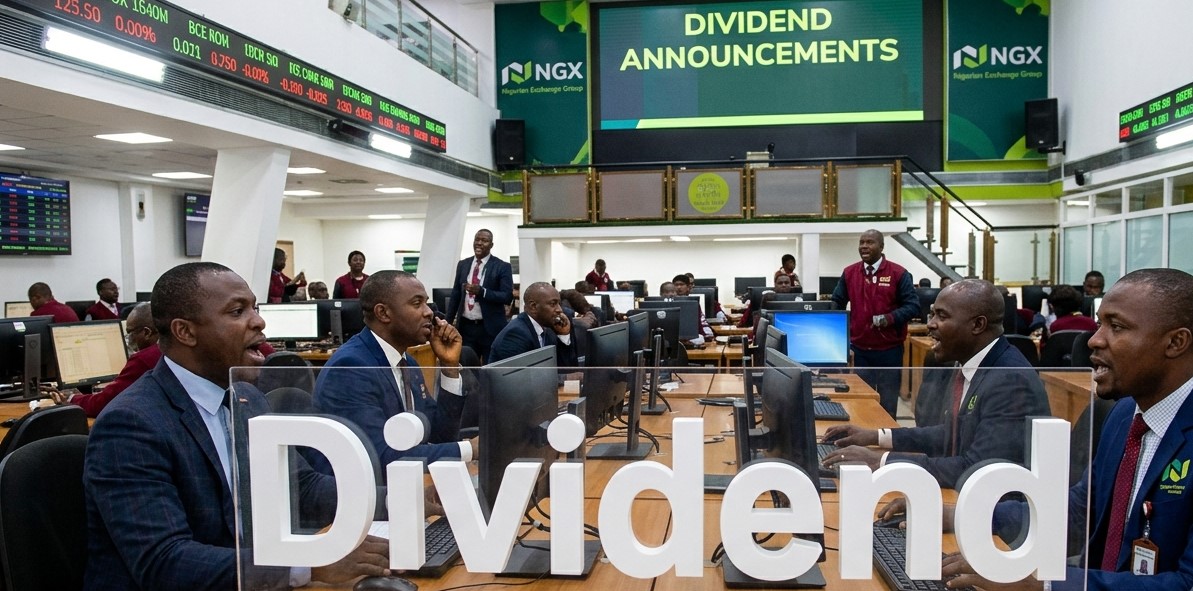
Investors seeking steady income from the Nigerian stock market have been rewarded handsomely in 2026, with several listed companies announcing record-breaking cash distributions following strong 2025 financial performances.
According to data on NGX, Airtel Africa Plc leads the pack after declaring the highest cash dividend on the Nigerian Exchange (NGX), paying ₦58.59 per share to shareholders. The telecommunications giant’s payout exceeded the record dividend announced by Dangote Cement Plc, reinforcing its position as one of Africa’s strongest cash-generating companies.
The list also reflects the continued dominance of the telecommunications, industrial, energy, banking and consumer goods sectors in delivering shareholder value.
Top 10 Highest Dividends Payouts on the NGX in 2026
| Rank | Company | Dividend per Share | Payment Date |
| 1 | Airtel Africa Plc | ₦58.59 | July 23, 2026 |
| 2 | Dangote Cement Plc | ₦45.00 | July 1, 2026 |
| 3 | BUA Foods Plc | ₦28.00 | July 14, 2026 |
| 4 | Aradel Holdings Plc | ₦23.00 | July 29, 2026 |
| 5 | MTN Nigeria Communications Plc | ₦20.00 | Final dividend paid May 5, 2026 |
| 6 | Guaranty Trust Holding Company (GTCO) | ₦12.76 | April 28, 2026 |
| 7 | BUA Cement Plc | ₦10.00 | May 21, 2026 |
| 8 | Geregu Power Plc | ₦9.00 | April 30, 2026 |
| 9 | Zenith Bank Plc | ₦10.00 (₦1.25 interim + ₦8.75 final) | Final paid May 5, 2026 |
| 10 | Nigerian Aviation Handling Company (NAHCO) Plc | ₦6.25 | May 15, 2026 |
Sector Analysis
The rankings reveal several important trends in Nigeria’s capital market.
The telecommunications sector dominates the top five, with Airtel Africa and MTN Nigeria continuing to reward investors through substantial cash distributions backed by strong earnings and robust cash flows.
The industrial sector remains another major dividend contributor. Dangote Cement and BUA Cement maintained their reputation as dependable dividend stocks, while BUA Foods’ ₦28.00 per share payout reflects the company’s strong profitability and cash generation.
In the energy sector, Aradel Holdings and Geregu Power delivered impressive returns, highlighting growing investor interest in Nigeria’s oil, gas and power industries.
The banking sector also maintained its long-standing tradition of rewarding shareholders. GTCO and Zenith Bank once again featured among the highest dividend-paying companies, underscoring the resilience and profitability of Nigeria’s leading financial institutions.
Why Dividend Stocks Matter
Dividend-paying companies remain attractive to investors seeking regular income in addition to capital appreciation. Firms capable of sustaining generous payouts often exhibit:
- Strong profitability.
- Healthy cash flows.
- Disciplined capital management.
- Stable business models.
- Confidence in future earnings.
For long-term investors, reinvesting dividends can significantly enhance overall investment returns through the power of compounding.
BuyerMetrics Bottom Line
The 2026 dividend rankings reinforce a key theme highlighted in BuyerMetrics’ recent analysis, “NGX Weekly: Nigerian Stocks Lose ₦2.43tn as Profit-Taking Deepens, Banking Shares Signal Buying Opportunities.” While the broader market experienced profit-taking, investors continued to favour fundamentally strong companies with resilient earnings, healthy cash flows and a consistent record of rewarding shareholders through dividends.
The latest dividend payouts validate that strategy. Companies such as Airtel Africa, Dangote Cement, BUA Foods, GTCO, MTN Nigeria and Zenith Bank continue to demonstrate that long-term shareholder value is created not only through share price appreciation but also through sustainable cash distributions. For investors building income-focused portfolios, dividend consistency supported by strong earnings and cash generation, remains one of the most reliable indicators of corporate quality.
As the second half of 2026 unfolds, investors will be watching whether these market leaders can sustain their dividend momentum while navigating inflationary pressures, interest rate movements, foreign exchange dynamics and evolving regulatory requirements.