




Nigeria’s stock market extended its recent pullback during the week ended June 26, 2026, with investors losing ₦2.43 trillion in market value as widespread profit-taking outweighed bargain hunting across most sectors.
Data released by the Nigerian Exchange (NGX) showed the All-Share Index (ASI) declined 1.65% to 232,049.02 points, from 235,941.27 points a week earlier, while total market capitalization fell 1.60% to ₦148.91 trillion.
The decline marked another difficult week for equities after months of strong gains that had pushed the market to record highs. Yet, despite the recent correction, the benchmark index remains 49.12% higher year-to-date, underscoring that the current selloff is largely a period of profit-taking rather than a reversal of the broader bullish trend.
NGX Trading activity weakens as investors become cautious
Investor participation slowed noticeably as market volatility encouraged many traders to lock in profits.
Total transactions dropped to 2.324 billion shares worth ₦134.49 billion in 249,328 deals, compared with 3.075 billion shares valued at ₦254.61 billion recorded a week earlier. Trading value declined by nearly 47%, indicating that institutional investors traded more cautiously despite continued market liquidity.
The Financial Services sector remained the market’s busiest segment, accounting for 65.53% of total trading volume after investors exchanged 1.523 billion shares worth ₦47.54 billion. ICT followed with 198.82 million shares valued at ₦32.62 billion, while Consumer Goods contributed 151.64 million shares worth ₦10.93 billion.
Access Holdings, Fidelity Bank and Chams Holding Company remained the most actively traded stocks, jointly accounting for almost 21% of total market volume, highlighting continued investor interest in highly liquid banking and technology counters.
Banking stocks buck the market trend
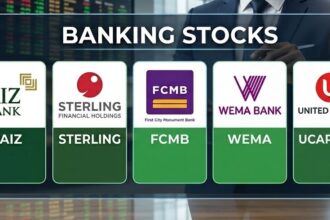
Although the broader market finished lower, banking stocks continued attracting investors.
The NGX Banking Index gained 3.51%, making it one of only a few sectoral indices to close the week in positive territory. The NGX AFR Bank Value Index advanced 3.28%, while the NGX AFR Dividend Yield Index rose 9.93%, reflecting continued demand for fundamentally strong dividend-paying stocks.
The sector’s resilience reflects growing investor preference for banks that continue to benefit from elevated interest rates, improving earnings, stronger capital positions and expectations of attractive dividend payouts.
Guaranty Trust Holding Company gained 10.69%, Zenith Bank added 4.50%, while First HoldCo rose 10%, extending the sector’s leadership despite weakness elsewhere in the market.
Oil and industrial stocks drag the market lower
The market’s losses were concentrated in heavyweight energy and industrial companies.
The NGX Oil & Gas Index declined 9.86%, making it the week’s weakest-performing sector, while the Industrial Goods Index lost 8.21%. Insurance stocks also remained under pressure, with the sector index falling 4.39%.
The weakness coincided with softer international crude oil prices after easing geopolitical tensions reduced fears of supply disruptions. Lower oil prices often weigh on investor sentiment toward energy stocks, particularly after extended rallies.
Industrial stocks also experienced profit-taking as investors rotated into sectors offering stronger near-term earnings momentum.
Market breadth remains negative despite more gainers
Market breadth improved slightly compared with the previous week but remained firmly negative.
Twenty-two companies recorded price gains, up from eleven the previous week, while fifty-seven stocks declined and sixty-seven closed unchanged.
McNichols Plc led the gainers with a 26.47% weekly increase, followed by International Energy Insurance (14.43%), Guaranty Trust Holding Company (10.69%), First HoldCo (10.00%) and Airtel Africa (10.00%.
On the downside, Trans-Nationwide Express lost 26.79%, Deap Capital Management declined 23.31%, Abbey Mortgage Bank shed 20.30%, while Aradel Holdings dropped 19%, contributing significantly to the decline in the Oil & Gas Index.
Corporate actions continue despite weaker market
The week also demonstrated that companies remain willing to access the capital market despite weaker secondary market performance.
First HoldCo listed 1.02 billion additional ordinary shares following its private placement, increasing its issued shares to 45.48 billion.
Ellah Lakes also completed the listing of 2.25 billion ordinary shares arising from the conversion of ₦6.31 billion in debt into equity, strengthening its balance sheet while increasing its share capital.
In addition, the Nigerian Exchange admitted the Federal Government’s June 2026 Savings Bonds, including the 13.777% FGS June 2028 and 14.777% FGS June 2029 issues.
These transactions reinforce the role of the Nigerian capital market as a platform for corporate financing even during periods of market consolidation.
Market Outlook: What investors should watch this week
The coming week will likely be shaped by five major factors:
- Whether bargain hunting emerges after two consecutive weeks of selling.
- Movement in global crude oil prices and their effect on oil-related stocks.
- Expectations ahead of the half-year corporate earnings season.
- Liquidity shifts between equities and high-yield fixed-income securities.
- Continued institutional accumulation of fundamentally strong banking stocks.
If profit-taking eases, banking, telecoms and other fundamentally strong large-cap stocks could provide support for the broader market. However, weaker oil prices and cautious investor sentiment may continue to limit gains in energy and industrial counters.
BuyerMetrics Bottom Line
The Nigerian market is transitioning from momentum-driven buying to fundamentally driven investing. The broad selloff has created selective opportunities, particularly in quality banking and dividend-paying stocks, while elevated interest rates and softer oil prices are likely to keep pressure on cyclical sectors. If upcoming corporate earnings meet expectations, the current correction could provide a healthier base for the market’s next leg higher.