




Behind closed doors in Lagos, Nigerian Exchange Group, NGX, is doing something far more consequential than hosting another industry roundtable; it is attempting to rewire how capital moves across Africa.
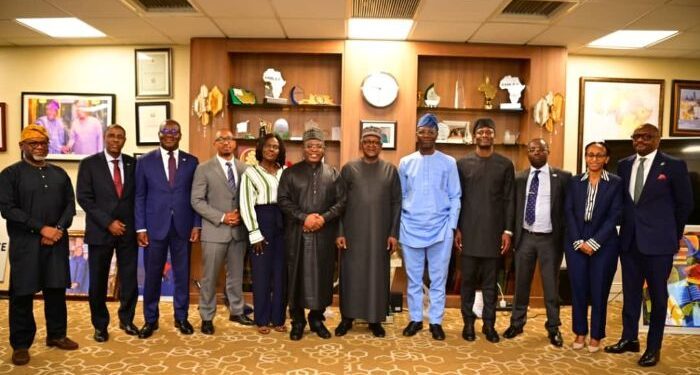
The gathering, convened by Group CEO Temi Popoola and Chairman Umaru Kwairanga, brought together a coalition of exchanges that collectively represent the spine of Africa’s capital markets: Johannesburg Stock Exchange, Ghana Stock Exchange, Nairobi Securities Exchange, Ethiopian Securities Exchange, and Bourse Régionale des Valeurs Mobilières.
But this was not just a policy conversation. It was also a positioning exercise.
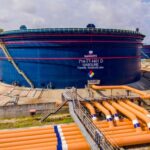
As part of the engagement, delegates were taken on a familiarization tour of the Dangote Refinery and its petrochemical complex, an asset widely expected to anchor one of the most consequential listings in African capital markets history.
Fragmented Liquidity Meets a Mega-Listing Moment
On the surface, the agenda was familiar: cross-border listings, investor access, and regional integration. But beneath that language sits a deeper shift; Africa is preparing for a new class of capital demand that its fragmented markets, in their current form, cannot absorb.
The refinery tour makes that reality tangible.
According to Umaru Kwairanga, the visit was not a ceremonial inspection but a strategic step toward listing readiness giving investors and advisers a clearer basis for valuation, risk assessment, and participation ahead of a planned IPO.
In effect, this is due diligence at a continental scale.
The presence of Aliko Dangote and SEC Director-General Emomotimi Agama reinforces that this is no longer theoretical. A pipeline of large-scale transactions led by industrial assets of this magnitude is forming, and it will test the limits of Africa’s current market structure.
Kwairanga framed it directly; “this is about evaluating the investment and ensuring the success of the listing, not just admiring the infrastructure”. His broader point is even more telling; “through cement, fertiliser, food, and now petroleum, Dangote’s model reflects a deeper continental shift from import dependence to industrial self-sufficiency”.
Capital markets now need to catch up with that shift.
From Competition to Coordination: Building for Cross-Border Execution
That is the real focus of this engagement.
Not just enabling companies to list in multiple jurisdictions, but reducing the friction that keeps capital trapped within borders. Not just attracting foreign investors, but unlocking intra-African capital flows that remain significantly underutilized. And critically, not just building infrastructure, but aligning incentives between exchanges, regulators, issuers, and intermediaries.
Related – Nigeria’s 2026 Forex Outlook: From Crisis To Managed Stability
Early signals suggest exchanges are positioning themselves less as standalone marketplaces and more as coordinators of a distributed financial network facilitating visibility, harmonization, and investor engagement, while leaving execution to issuers and their advisers.
This distinction matters. It reflects a shift from competition to orchestration especially critical when a transaction of the refinery’s scale could require liquidity far beyond a single market.
BuyerMetrics Bottom Line: The Integration Imperative
This is not about cooperation for its own sake; it is about necessity. Africa is entering a phase where capital requirements across infrastructure, energy, industrialization, and corporate expansion are scaling faster than local markets can independently support. Without integration, large deals will either migrate offshore or stall entirely.
NGX’s move signals an early attempt to prevent that outcome using a flagship transaction like the Dangote refinery IPO to force coordination across markets.
If successful, the implications are significant: deeper liquidity, improved price discovery, broader investor participation, and a re-rating of African assets as accessibility improves.
But execution risk remains high. Regulatory misalignment, currency volatility, settlement infrastructure gaps, and differing market maturities are not trivial barriers.
Still, the direction is now clearer than ever. Africa’s next capital market evolution will not be driven by individual exchanges growing bigger; it will be driven by them becoming more connected.